
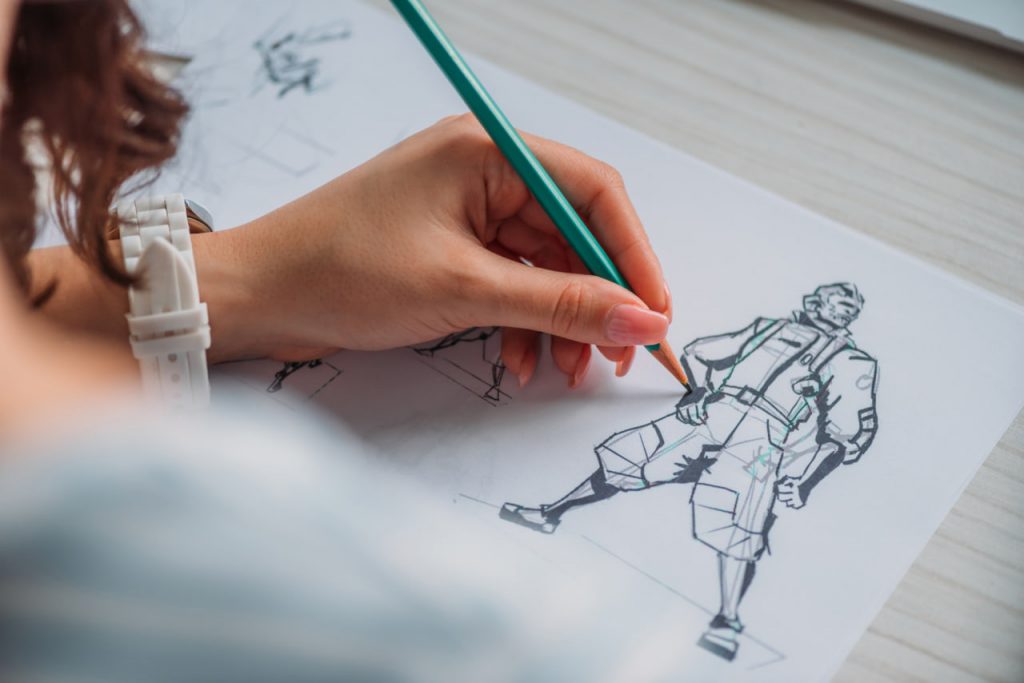
Perspective is a major basic that enables you to give your drawings the illusion of space and three-dimensionality. Even if the proportions of your subject are perfect, if your perspective is off, your drawings will lack the illusion of depth. Perspective is what lets you show space, distance and volume in your work.
No matter if you’re sketching the natural world, an urban environment, a room or a tricky subject, it’s important to have some understanding of perspective if you want to accurately depict what you see and make your sketches pop.
The Fundamentals of Perspective
Perspective is a way of drawing things so that they seem smaller and farther away or larger and closer. Parallel lines appear to converge on the horizon.
Horizon Line- The line on the page or canvas that the viewer is looking out from, where all vanishing points are on. This line grounds the drawing and allows the viewer to have a sense of the objects relationship to them.
Horizon line is the line which represents the eye level of the viewer. Vanishing point is the point on the horizon line where the parallel lines seem to meet. The perspective can be broadly classified into three types based on the number of vanishing points 1. One-point perspective. 2. Two-point perspective. 3. Three-point perspective.
Perspective: One-Point Perspective
The easiest perspective to create is a one-point perspective and is used when objects are directly facing the viewer.
Features
One vanishing point on the horizon line
Converge parallel lines to it
Good for roads, corridors, train tracks, or rooms looking directly into the view
Procedimiento Draw the horizon line and determine where the vanishing point is. Then draw any box, piece of furniture, etc. so that the lines run toward the vanishing point. This will give the impression of depth and distance.
2-Point Perspective: At least two vanishing points are used to create the illusion of a 3-dimensional space on a flat surface. The resulting drawings often have a more dynamic perspective.
Two-point perspective is used when an object is seen from a corner.
Features
Two vanishing points are on the horizon line.
Vertical lines are always parallel, but horizontal lines are going to converge at both vanishing points
Perfect for: buildings, streets, or any other angles you find in the wild
Approach
Horizon line and two vanishing points to begin with. Vanishing lines from vertical lines to their respective vanishing points. A technique which, when done correctly, works well to suggest a three-dimensional space in an oblique drawing.
Perspective: 3-Point
Three-point perspective is employed for dramatic or exaggerated views, for example when looking up or down a building.
Features
Three vanishing points: two on the horizon line, one above or below the horizon
Captures both height and depth at the same time
Typically used for dramatic, cinematic imagery
What to do: Once you’ve found your horizon line and two vanishing points on that line, create a third vanishing point for vertical lines. Lines will converge with all three points to create either great height or great depth.
Perspective and Proportion Corrections
Here’s an example of foreshortening: when you look at an object from a distance or an angle, it will appear foreshortened, or shortened. This is perspective: things closer to you appear larger, and things further away appear smaller. Exercising your ability to draw things in foreshortening will increase the overall believability of your artwork and help you to create more interesting, dynamic scenes.
Draw your proportions from vanishing points and the horizon line to keep your objects in proportion to each other. Compare the proportions of objects to each other as well. Measure heights and lengths of objects in relation to other objects. Don’t distort perspective.
Here are some suggestions for practicing perspective:
Start Simple
Start with simple forms such as boxes, rectangles and cylinders and practice both one-point and two-point perspective on them before moving onto more detailed environments.
Use Photo Reference An environment like this helps to illustrate vanishing lines, size, and distance. Having photos like these can aid you in understanding perspective.
Construct Grids. Apply perspective to a grid to help you position elements in the drawing and ensure they are proportional to the rest of the drawing. With a light line, draw edges, streets, and buildings towards vanishing points.
Combine Multiple Techniques: Use a combination of foreshortening, overlapping, and atmospheric perspective ( objects in the distance are lighter and less defined) for a more realistic effect.
Common Issues and Resolutions
Incorrect Vanishing Points Vanishing points should be correctly positioned so that the vanishing lines correctly terminate on them. Check the alignment of the vanishing points to ensure that the perspective doesn’t appear distorted.
Flat Drawings Overlapped, different scales, and texture create depth. Can add depth with shading and lighting.
Confusing Angles: Start by figuring out the basic geometric shapes that make up an object, applying perspective to those shapes, and only then filling in the details. You will always avoid mistakes by following a system of increasing refinement.